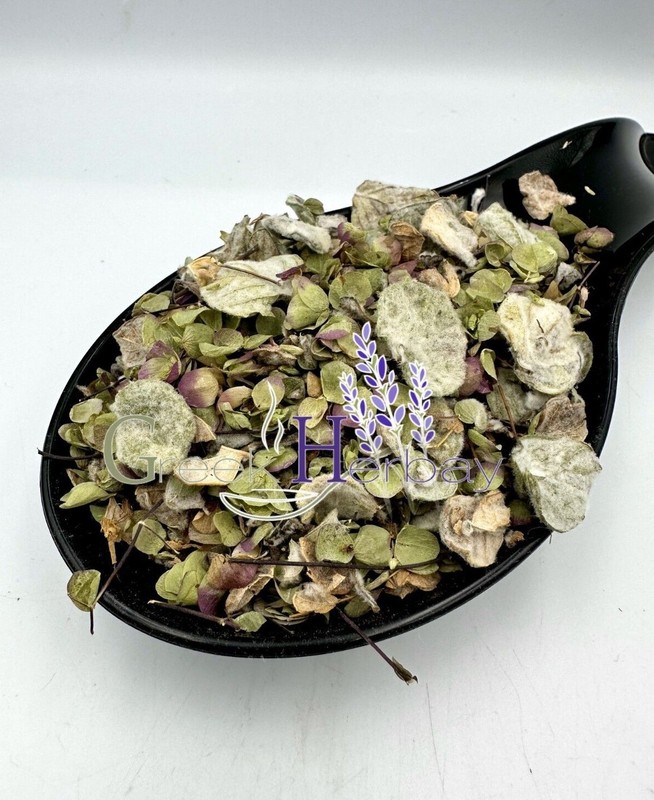


Greek Dittany Of Crete Loose Leaf Herbal Tea 25g - 920g - Origanum Dictamnus Dittany, also known as erontas, is the most famous Cretan herb and endemic plant that grows only in Crete. As an herb, dittany has been famous since the time of Minos for its healing properties and its cultivation is very widespread on the island, mainly as an amateur, in pots and rock gardens, but also professionally in mountainous areas, as the natural populations of the plant have decreased. significantly from the reckless collection. Dittany is a perennial aromatic plant, a cousin of oregano, which retains its leaves in winter and has a slow growth that reaches a height of 30-40 cm. It has small round gray-green leaves covered with white soft fluff and characteristic light pink flowers that appear in the summer season.The name diktamo comes from the combination of the name of the mountain Dikti located in the prefecture of Lassithi and the word "bush". Regarding the other name of the dittany, the "love", the prevailing interpretation comes from those who picked it from steep and rocky locations, so it is considered that he had a risky passion for the plant, equivalent to love. Origin:Greece Greek HISTORY Known since antiquity as a panacea for many ailments as well as wound healing. The plant was dedicated to the goddess Artemis because it was believed to facilitate childbirth, which is why in the representations of the goddess she was usually depicted crowned with dittany branches. It used to be very popular as the herb of 'love and youth' and was believed to enhance sexual arousal. In the Middle Ages, dittany became famous thanks to its use in the famous digestive liqueur Benedictine.Known for its hemostatic action, it has been observed that the wounded ibex of Crete often eat dittany in order to be healed, while there are historical records that report that deer wounded by archers ate dittany and the arrow was receding from the wound! The contents of this website do not constitute and cannot be construed as medical advice, diagnosis, treatment or indication. All information is provided to readers by health professionals, for informational purposes only. There is no intention for this content to replace personalized medical advice, diagnosis, prognosis or treatment.
| Return Shipping Will Be Paid By | Buyer |
| All Returns Accepted | Returns Accepted |
| Item Must Be Returned Within | 30 Days |
| Expiration Date | 10/26 |
| Allergens | Dittany tea |
| Form | Loose Leaf |
| Product | Tea & Infusion |
| MPN | Does not apply |
| Regional Cuisine/Region | Greek |
| Calories Per Serving | 0,1kg |
| Flavor | Unflavored |
| Brand | Greekherbay |
| Food Aisle | Pantry |
| Type | Herbal/Tisane |
| Food Specifications | No Artificial Coloring |
| Country/Region Of Manufacture | Greece |
| Serving Size | 1 Cup |
| Item Weight | 2 kg |
Greek Dittany Of Crete Loose Leaf Herbal Tea 25g – 920g – Origanum Dictamnus Dittany, also known as erontas, is the most famous Cretan herb and endemic plant that grows only in Crete. As an herb, dittany has been famous since the time of Minos for its healing properties and its cultivation is very widespread on the island, mainly as an amateur, in pots and rock gardens, but also professionally in mountainous areas, as the natural populations of the plant have decreased. significantly from the reckless collection. Dittany is a perennial aromatic plant, a cousin of oregano, which retains its leaves in winter and has a slow growth that reaches a height of 30-40 cm. It has small round gray-green leaves covered with white soft fluff and characteristic light pink flowers that appear in the summer season.The name diktamo comes from the combination of the name of the mountain Dikti located in the prefecture of Lassithi and the word “bush”. Regarding the other name of the dittany, the “love”, the prevailing interpretation comes from those who picked it from steep and rocky locations, so it is considered that he had a risky passion for the plant, equivalent to love. Origin:Greece Greek HISTORY Known since antiquity as a panacea for many ailments as well as wound healing. The plant was dedicated to the goddess Artemis because it was believed to facilitate childbirth, which is why in the representations of the goddess she was usually depicted crowned with dittany branches. It used to be very popular as the herb of ‘love and youth’ and was believed to enhance sexual arousal. In the Middle Ages, dittany became famous thanks to its use in the famous digestive liqueur Benedictine.Known for its hemostatic action, it has been observed that the wounded ibex of Crete often eat dittany in order to be healed, while there are historical records that report that deer wounded by archers ate dittany and the arrow was receding from the wound! The contents of this website do not constitute and cannot be construed as medical advice, diagnosis, treatment or indication. All information is provided to readers by health professionals, for informational purposes only. There is no intention for this content to replace personalized medical advice, diagnosis, prognosis or treatment.